




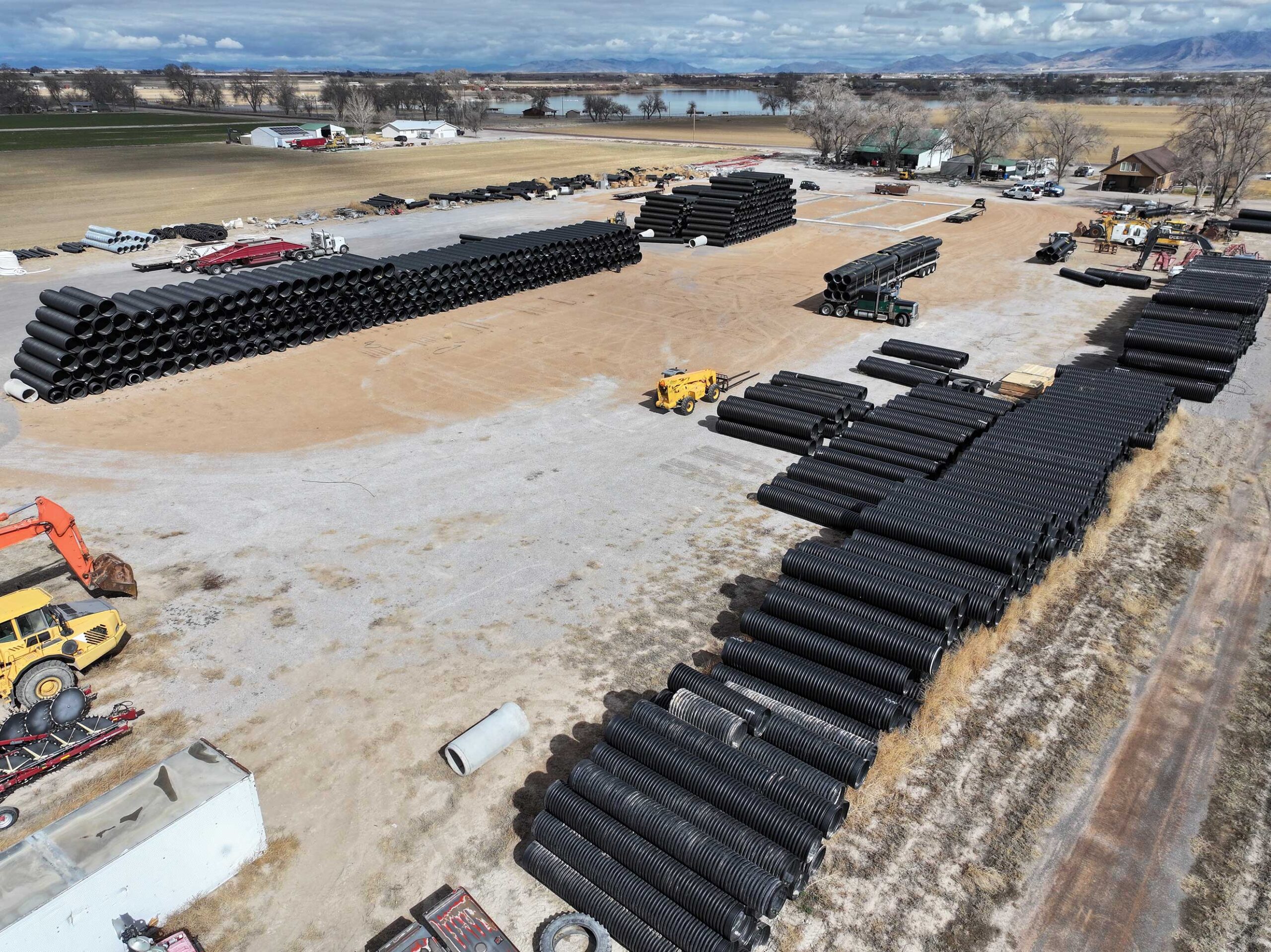
In the Midwest, contractors fight against water.
In Utah, they fight for it. Shawn Peterson is the owner and founder of Great Basin Pipe & Irrigation, a company built around the reality of life in the West.

“We are dry out here,” Shawn says. “Water is precious.”
Founded in 2022, Great Basin may be a young company on paper, but Shawn’s experience in the field goes back much further. A grain merchandiser and farmer by trade, he installed his first section of pipe more than ten years ago.
“It was just hit or miss at first,” Shawn recalls. “Word of mouth. One job here and there.”
Over time, those jobs became more frequent. Farmers needed better irrigation systems. Water management 8 became more urgent. In 2021, a local farmer contacted Fratco looking for irrigation pipe. Shawn and his crew installed that system, which sparked an ongoing partnership. By the following year, Great Basin Pipe & Irrigation was officially formed and operating as a Fratco distributor focused entirely on irrigation.
“We don’t do drainage,” Shawn says. “It’s purely irrigation.” That difference defines everything about his business.
Installing Fratco’s All-in-One Water Transportation System
Every irrigation project Great Basin installs today centers around Fratco’s All-in-One Water Transportation System, developed by Fratco through a team led by Jerry Weiland.
The system combines HDPE pipe, stainless steel control structures and connection components into one coordinated design. Instead of piecing together materials from multiple sources, the All-in-One system is engineered to work together from start to finish.
For Shawn, that coordination matters.
“You have to calculate everything to get the amount of water the farmer wants,” he explains. “The system has to be designed right from the beginning.”
Fratco supplies the pipe and partners with Buffalo Ridge Metalworks for the stainless steel control structures. Shawn and his crew assemble those stainless structures based on the specific needs of each job. Marmac couplers are used to complete the connections in the field.
Once all of the materials arrive, the crew can assemble and install without waiting on separate fabrication steps.
The result is a system designed for efficiency, durability and long term performance in demanding western conditions.

A Different Kind of Challenge
For many Tried & True readers in the Midwest, the challenge is removing excess water. Fields need drainage to stay productive. In Utah, the challenge is the opposite.
The Midwest is looking to get rid of water,” Shawn says with a laugh. “Out here, we’re looking for ways to put more water in the ground.
Every irrigation system begins with careful planning, just like with drainage systems. Before a single trench is dug, the land must be surveyed. Grade is critical. Water must flow at the right rate to reach the desired parts of the field.
“You have to survey it. You have to know your grade,” Shawn says. “If it’s not right, it’s not going to work the way the farmer needs it to.”
Designs are developed based on those measurements. Pipe layout, structures and flow points are planned before installation begins. The system is then installed according to exact specifications.
In a region where rainfall cannot be counted on, precision matters.
The Great Salt Lake Connection
Water conservation in Utah extends beyond individual farms. It connects directly to the future of the Great Salt Lake.
Over the past two decades, the lake has experienced a dramatic decline due to prolonged drought and upstream water use. Lower water levels have raised concerns about dust storms from exposed lakebed, wildlife habitat loss and long term environmental impact for surrounding communities.
“It’s a big deal out here,” Shawn says. “A lot of people are worried about the lake.”
Northern Utah plays a major role in supplying water that eventually feeds the Great Salt Lake. Improving irrigation efficiency helps reduce unnecessary loss and supports broader conservation efforts.
Programs such as NRCS and the Utah Water Optimization Program provide funding to help farmers modernize irrigation systems. These initiatives are part of a statewide effort to protect water resources and stabilize lake levels.
“There’s a lot of pipe going in up north,” Shawn says. “That’s because the water needs to go into the lake.”
For Great Basin, installing Fratco’s All-in-One Water Transportation System is not just about crop production. It is about using water responsibly in a region where supply is never really guaranteed.
Soil Conditions Shape the System
Irrigation methods in Utah vary depending on terrain and soil conditions.
In many areas around Delta, flood irrigation remains common. The region’s soils often contain high levels of alkali and salt. Without enough water applied across the surface, those salts can rise toward the top layer of soil and damage crops.
“If you don’t flood it, those salts like to come up,” Shawn explains. “Plants don’t like that.”
Flood irrigation helps push salts down below the root zone. In flatter areas, this method remains effective and practical.
In areas such as Circleville, where fields are less level and closer to mountainous terrain, pivot systems are more common. Steeper ground makes flood irrigation difficult. Installing a pivot can be more efficient than leveling land.
“It depends on the farm you’re on,” Shawn says. “Location makes a big difference.”
Every job starts with understanding the land first.
From Concrete to Stainless
Before transitioning to Fratco’s All-in-One Water Transportation System, concrete control structures were standard. After pipe was installed, crews had to wait for concrete contractors to pour floors, then walls, then diversion bowls in stages.
“It just took forever,” Shawn says. “It was hard on the installer. Equipment had to move in and out multiple times. Scheduling delays slowed projects during the already short irrigation off season.
Working with Fratco and Buffalo Ridge Manufacturing, Shawn moved to stainless steel structures that could be assembled and installed more efficiently.

SmoothCorr pipe connects to the stainless steel control structure which manages water flow and diversion. “Jerry was a big part of that,” Shawn says. “He said, let’s find something that’s more plug and play.”
Several revisions were made along the way to refine the design and improve installation. Today, the stainless structures reduce time in the field and simplify the overall process.
“It took several revisions to get where we’re at,” Shawn explains. “But it’s a lot easier now.”
A stainless steel water dispersion bowl preventing soil erosion and damage. That efficiency is critical when irrigation water shuts off October 1 and returns April 1. When the water shuts off before the freeze, this is prime time for Shawn and his team to install the All-in-One Water Transportation Systems.
“We stay busy from October to April,” Shawn says. “That’s our window.”
A Family Operation
Great Basin operates with a small, tight knit crew. Shawn employs three full time team members, all of them family.
His nephews, Tyler Atkinson, Jace Atkinson and Kylan Nelson, work alongside him in the field. Shawn’s son, Ruger, who is 14, helps clean the shop and works in the field when he’s not in school. Another son, Caden, has helped with fabricating weed catchers and maintenance on the equipment. Another son, Cael, has also worked with the company, but is now pursuing a career as a lineman.

“We have a lot of fun together,” Shawn says.
The team replaces aging metal river pipes, digs water lines, builds farm roads and constructs retention ponds. They also take on seasonal agricultural projects to stay busy year round.

Of course, working Western ground comes with its own surprises. In the spring, trenching can uncover bullsnakes, locally known as blow snakes, that have been hibernating underground.
“You’ll pull up a bucket and there might be six or seven in there,” Shawn says.
It is simply part of working in the West.
Expanding to the West Coast
Earlier this year, Great Basin completed its first installation in Southern California using Fratco’s All-in-One Water Transportation System.
A farmer interested in becoming a distributor traveled to Utah to see the systems in operation.
“He wanted to see it, touch it, walk through it,” Shawn says.
After seeing the system firsthand, the farmer moved forward. Pipe and stainless structures were shipped, assembled and installed. Water has already run through the new system.
Like Utah, California depends heavily on careful water management. The expansion reflects growing interest in coordinated irrigation systems designed for dry climates.
Built for Where They Stand
Shawn Peterson built Great Basin Pipe & Irrigation around the realities of his region. It is practical work rooted in farming experience. It is shaped by drought, soil conditions and the responsibility that comes with managing limited water.
You’ve got to make it work with the ground you’re on.
While many contractors featured in these pages focus on drainage, Shawn’s work highlights the other side of water management. Instead of moving excess water away, his systems guide it exactly where it needs to go.
In a place where the future of the Great Salt Lake remains uncertain and every growing season depends on careful planning, that responsibility carries weight.
Out West, water is not something you take for granted.
And for Shawn Peterson and Great Basin Pipe & Irrigation, that makes all the difference.